
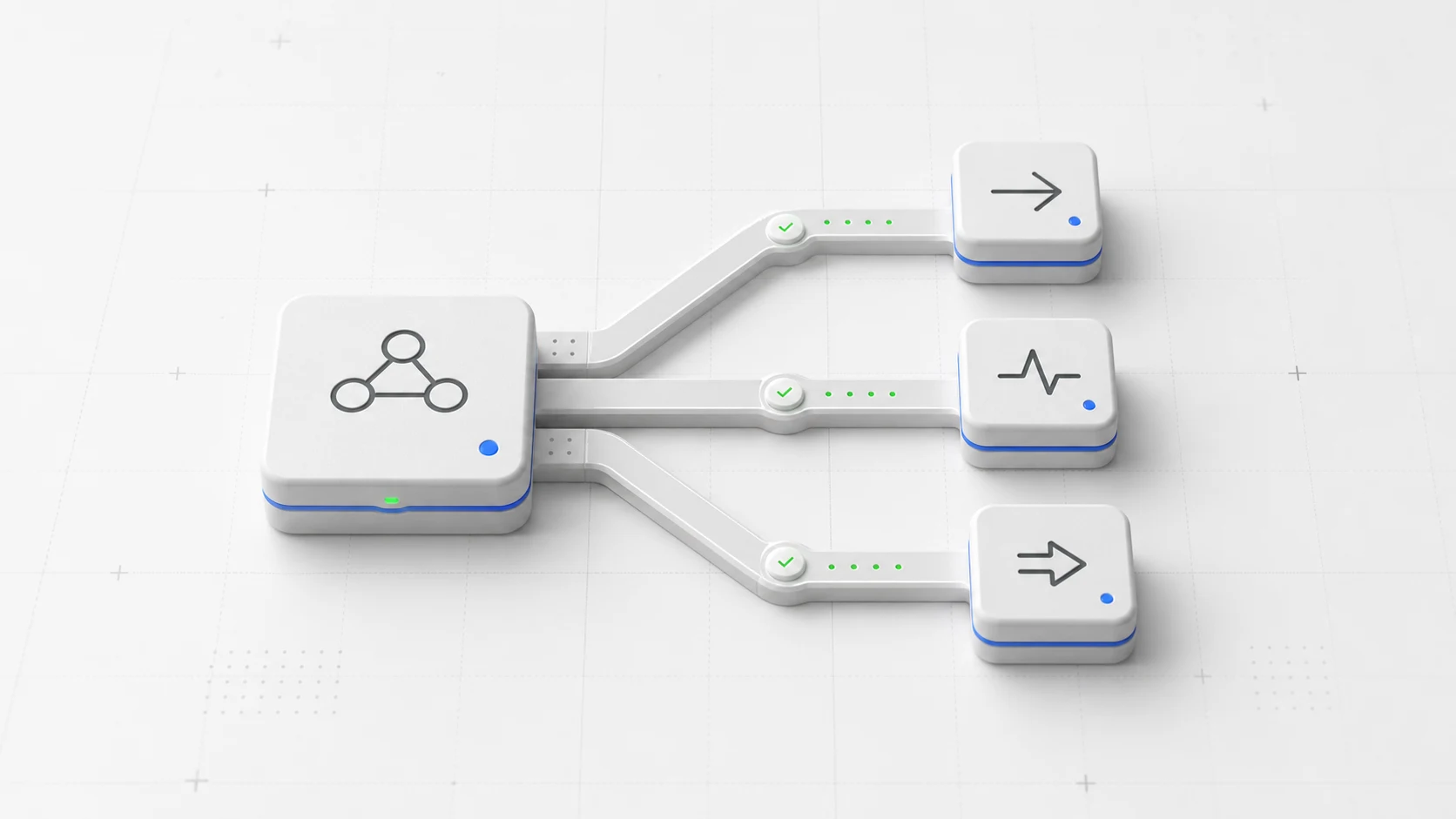
No platform is an island. Sooner or later, a real workflow needs to talk to something on the outside — a payment provider, a shipping service, an internal system, a partner's API. Making a single call is rarely the hard part. The hard part is doing it safely and repeatably: where do the credentials live, who can use them, how do you avoid pasting a secret key into a script, and how do you reuse the same integration across a dozen different processes without rebuilding it each time?
The platform now answers that with a dedicated framework for custom connectors — a first-class way to package an integration once, give it the credentials it needs, and use it everywhere, with none of the usual sprawl of one-off scripts and hard-coded secrets.
A home for your integrations
A connector is a proper, managed object: a named, reusable integration with an external system, configured in one place and available across the platform. Instead of the same outbound logic copied into several automations — each with its own slightly different copy of the credentials and the quirks — you define the connector once. When the external service changes, you update one thing. The integration becomes an asset you maintain, rather than scattered code you hope still works.
Credentials that stay where they belong
The most important thing a connector holds is also the most sensitive: the keys to the system it talks to. Connectors are built to carry authorization securely — API keys and tokens, and full OAuth 2.0 flows for services that require them — so the credentials live inside the connector rather than in the body of an automation or, worse, in plain sight in a script. The people who build processes can use a connector without ever handling the raw secret behind it. That is the difference between an integration that is convenient and one that is also safe to hand around your team.
A frontend when you need one
Some integrations are just a credential and an endpoint. Others need a little more: a setup screen, a way to pick an account, a small interface for the people who configure or operate them. When that is the case, a connector can carry its own custom frontend — a purpose-built piece of UI that lives with the connector itself. When it is not needed, you skip it. The framework scales from the simplest token-and-go integration to one with its own tailored experience, without forcing either shape on you.
First-class in your automations
A connector is only as useful as the places you can call it. Connectors plug directly into automations, so reaching an external system becomes just another step in a workflow — alongside conditions, branches, and everything else the builder offers. An automation can authenticate through a connector and act on an outside service as a natural part of its flow, which means your internal processes and your external integrations are designed in the same place, with the same tools, rather than stitched together across systems.
Safe by design
Flexibility and safety have to arrive together. Custom connectors run within clear boundaries — scoped to where they belong and isolated from one another — so the freedom to build your own integration never becomes a way around the platform's guarantees. You get room to connect to anything you need, inside limits that keep one integration from reaching into territory it should not.
Why it matters
The usual way to add a custom integration is to build a small piece of middleware: somewhere to keep the credentials, somewhere to run the glue code, somewhere new to monitor and secure. Connectors collapse all of that into the platform. You build the integration once, the platform keeps its credentials safe, and every process that needs it can call it without ever touching a secret.
Connectors sit naturally beside the rest of the platform — they are driven from automations, they can power custom apps, and they complement secrets management as the sanctioned way to reach the systems your work depends on. The result is fewer moving parts, fewer places for a credential to leak, and a single, consistent way to connect to the outside world.