
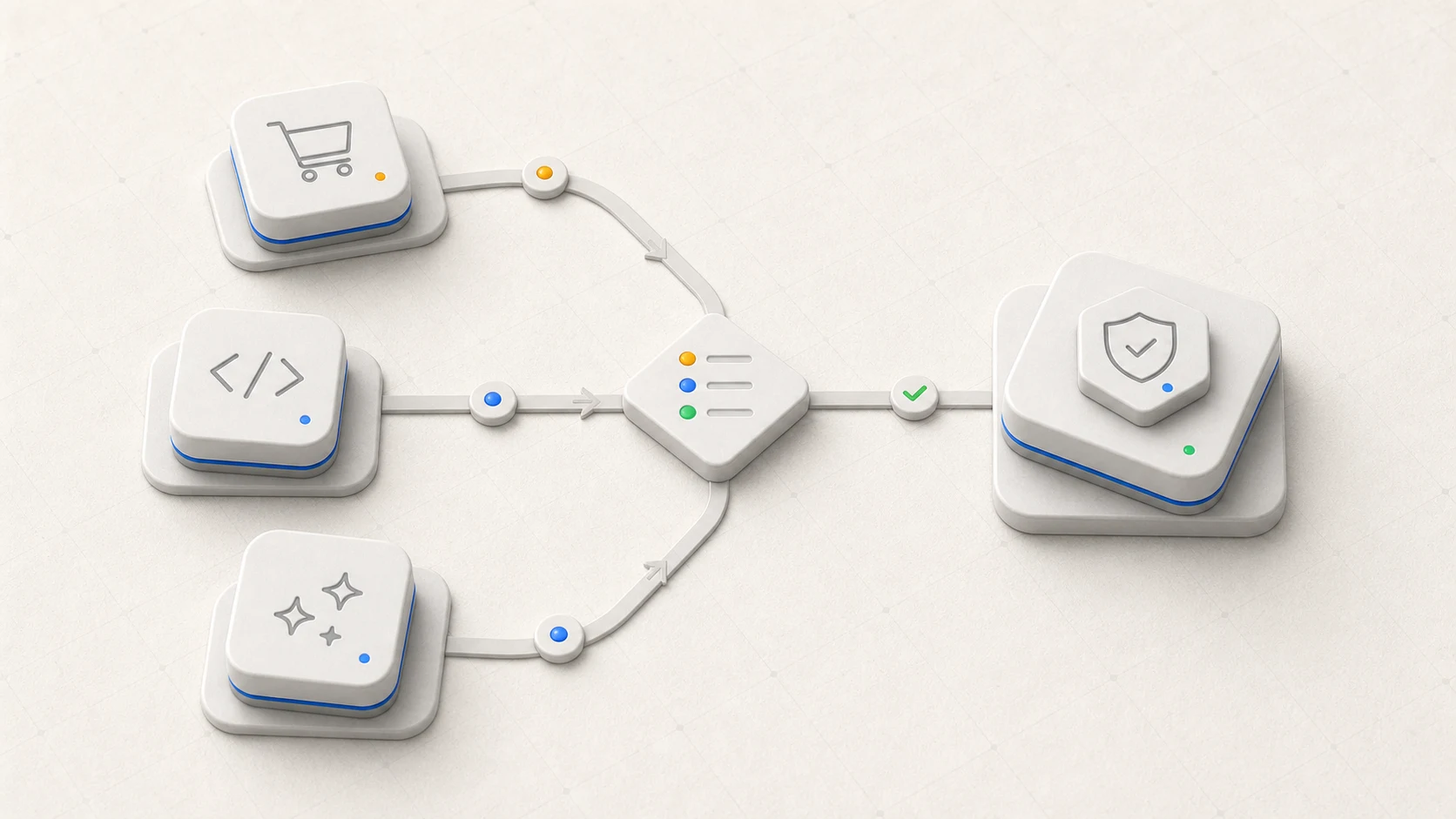
We have written before about talking to the platform from any AI tool — the platform exposing its own data and capabilities so that an assistant can work with them directly. This is the mirror image of that idea. Now the platform's own AI can reach outward, to the tools and systems that live beyond it.
The platform can now connect to external MCP servers — and that quietly widens what its AI can do from "everything inside this platform" to "everything you choose to plug in."
A quick word on MCP
MCP — the Model Context Protocol — has become the common language for giving AI access to tools. A service exposes its capabilities as an MCP server; an AI that speaks MCP can discover those capabilities and use them. The platform already runs its own MCP server, which is how its AI gets such fluent access to your data. The open standard means any number of other systems speak the same language — and now the platform's AI can talk to them too.
Beyond the platform's own tools
Until now, the AI's reach was defined by the platform itself: rich access to your data, your records, your model. That is a lot, but it is a boundary. By connecting an external MCP server, you extend that reach to whatever that server offers — a knowledge base, a search service, a specialized tool, another system entirely. The platform's AI is no longer limited to what lives in one place; it can act across the set of tools you decide to connect.
Used everywhere the AI runs
The important part is that this is not bolted onto one feature. A connected external MCP server is available across the platform's AI surfaces — the chat assistant, AI-driven conversations launched from your automations, and the agentic runs that work through a task across multiple steps. Connect a server once, and every place the AI operates can draw on it. The capability follows the AI rather than being trapped in a single screen.
Secure connections
Reaching an outside service means authenticating to it properly. External MCP connections support the standard mechanisms you would expect — OAuth flows for services that require them, and token-based authentication for those that do not — along with the discovery and registration steps needed to set a connection up cleanly. The result is a connection you can stand up deliberately and trust, not a fragile hand-rolled bridge.
Internal and external, together
The real power shows up when both sides combine in a single run. An agentic task can read and reason over your platform data through the internal tool layer and reach an external MCP server in the same flow — pulling in outside context, acting on another system, then coming back to update your records. The internal and the external stop being separate worlds; they become one toolset the AI can move freely across.
Why it matters
An AI is only as capable as the tools within its reach. By embracing the open MCP standard on both sides — exposing the platform's own capabilities, and now consuming anyone else's — the platform positions its AI not as a clever feature locked inside one product, but as something that can operate across your whole landscape of tools and data.
Together with the chat assistant, the AI-driven automations, and the agentic runs, external MCP support turns "the platform's AI" into "your AI, wherever your tools happen to live." That is a meaningfully larger ambition, and it is now built in.